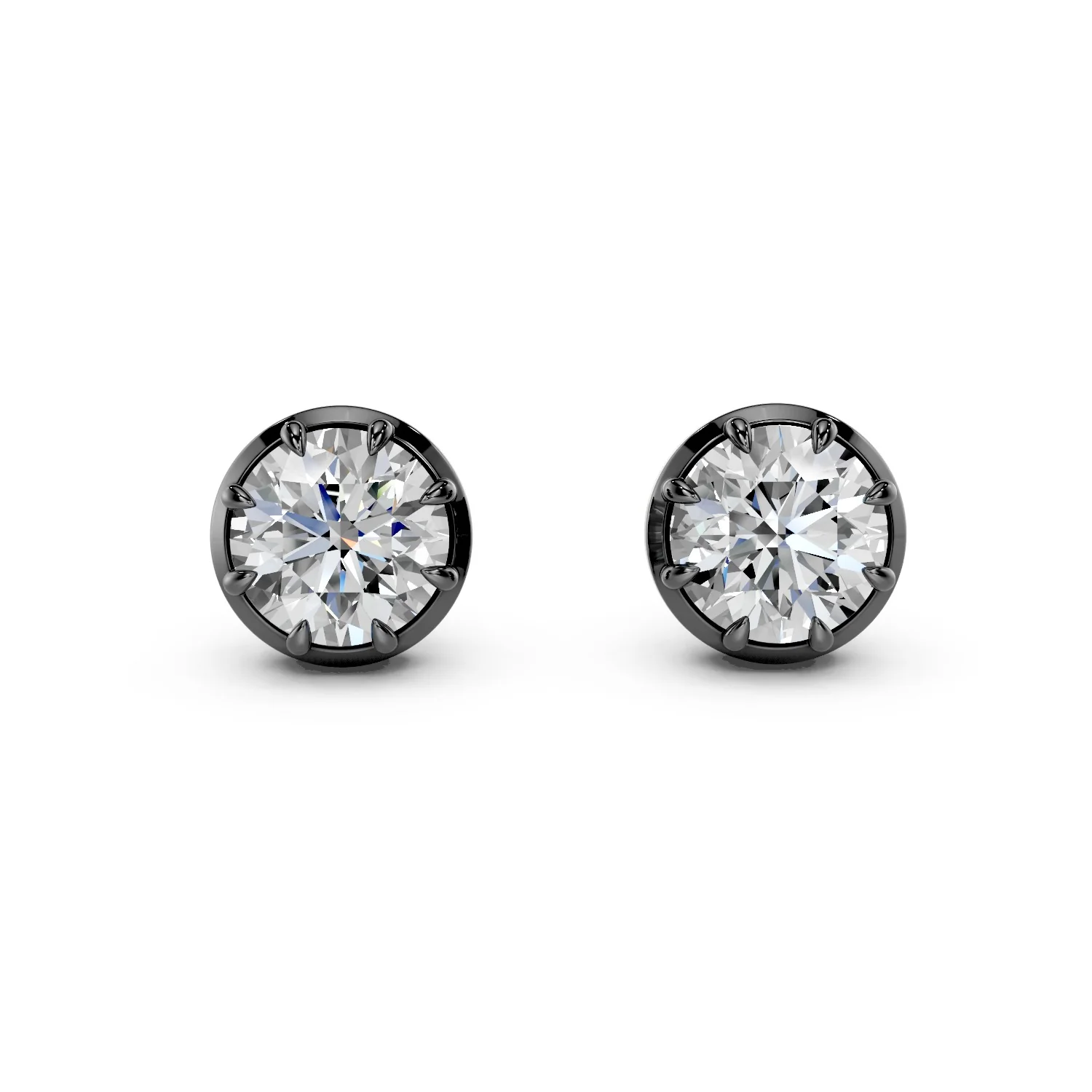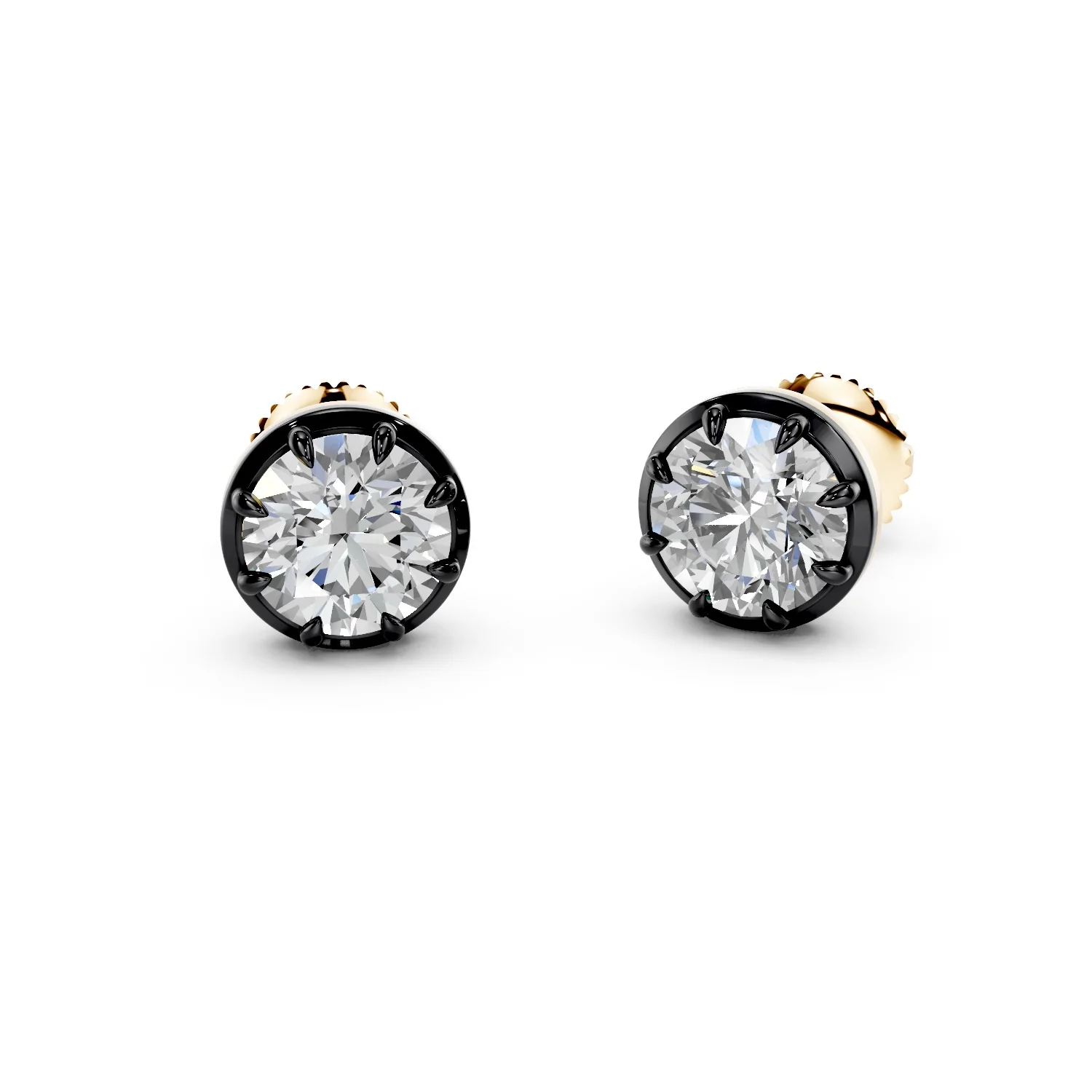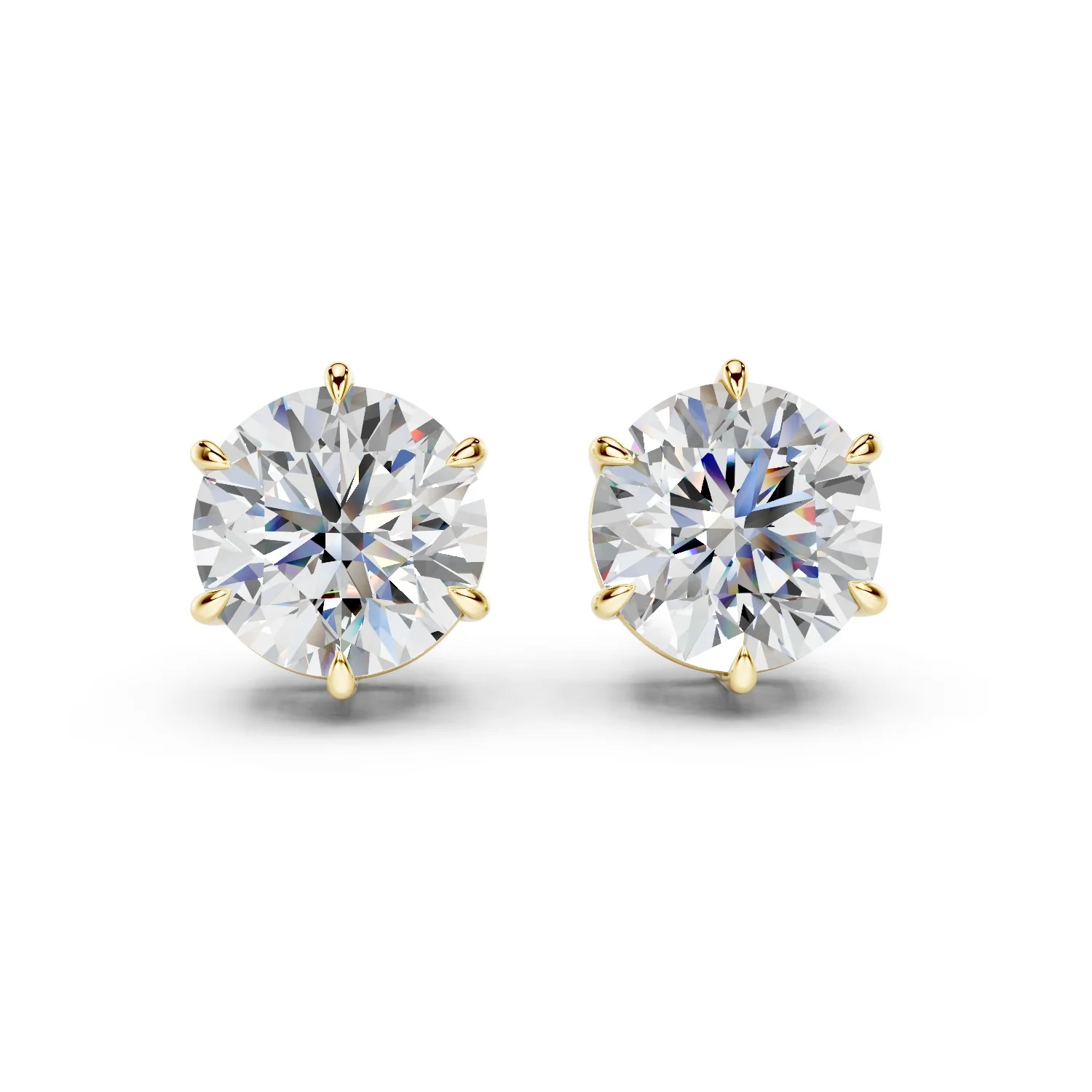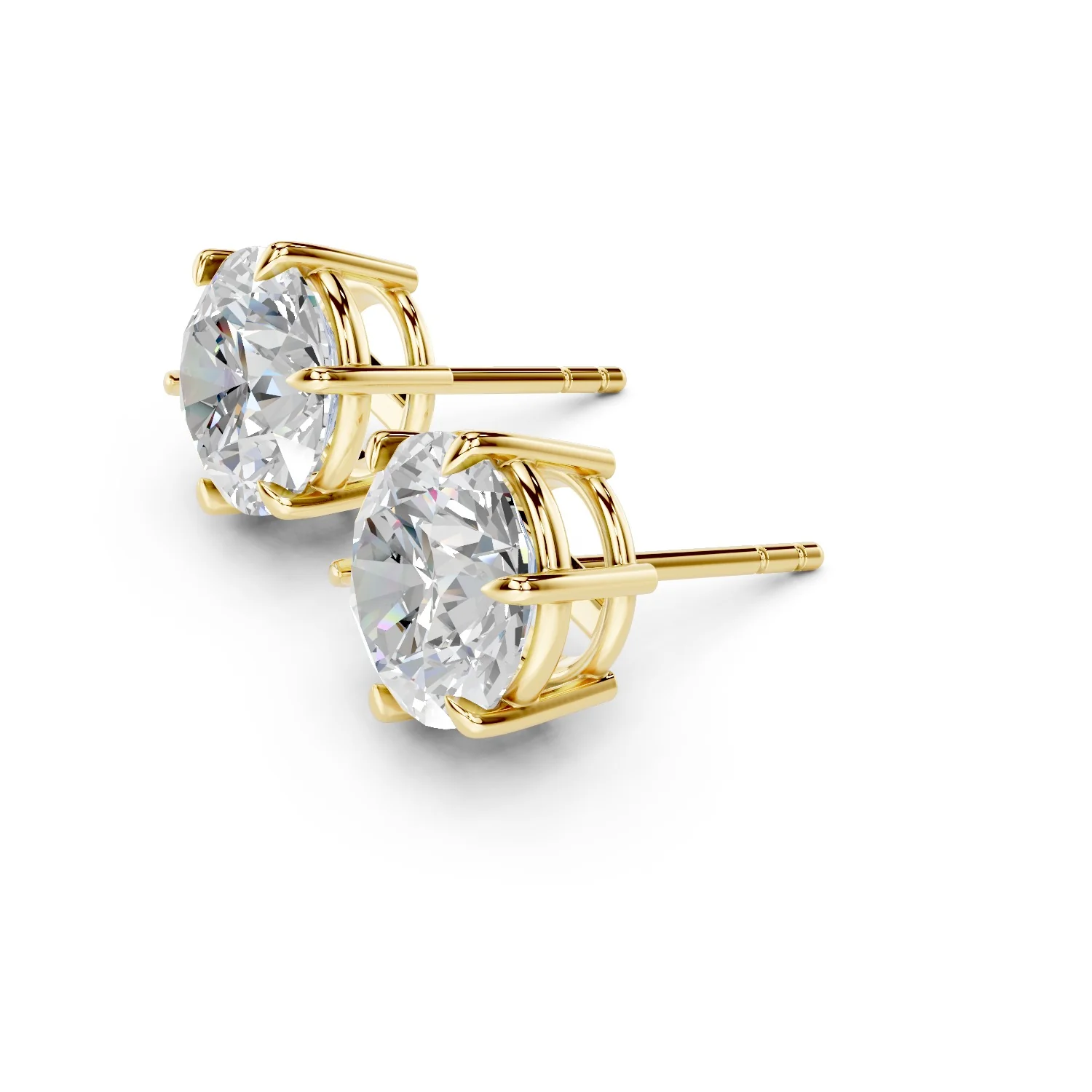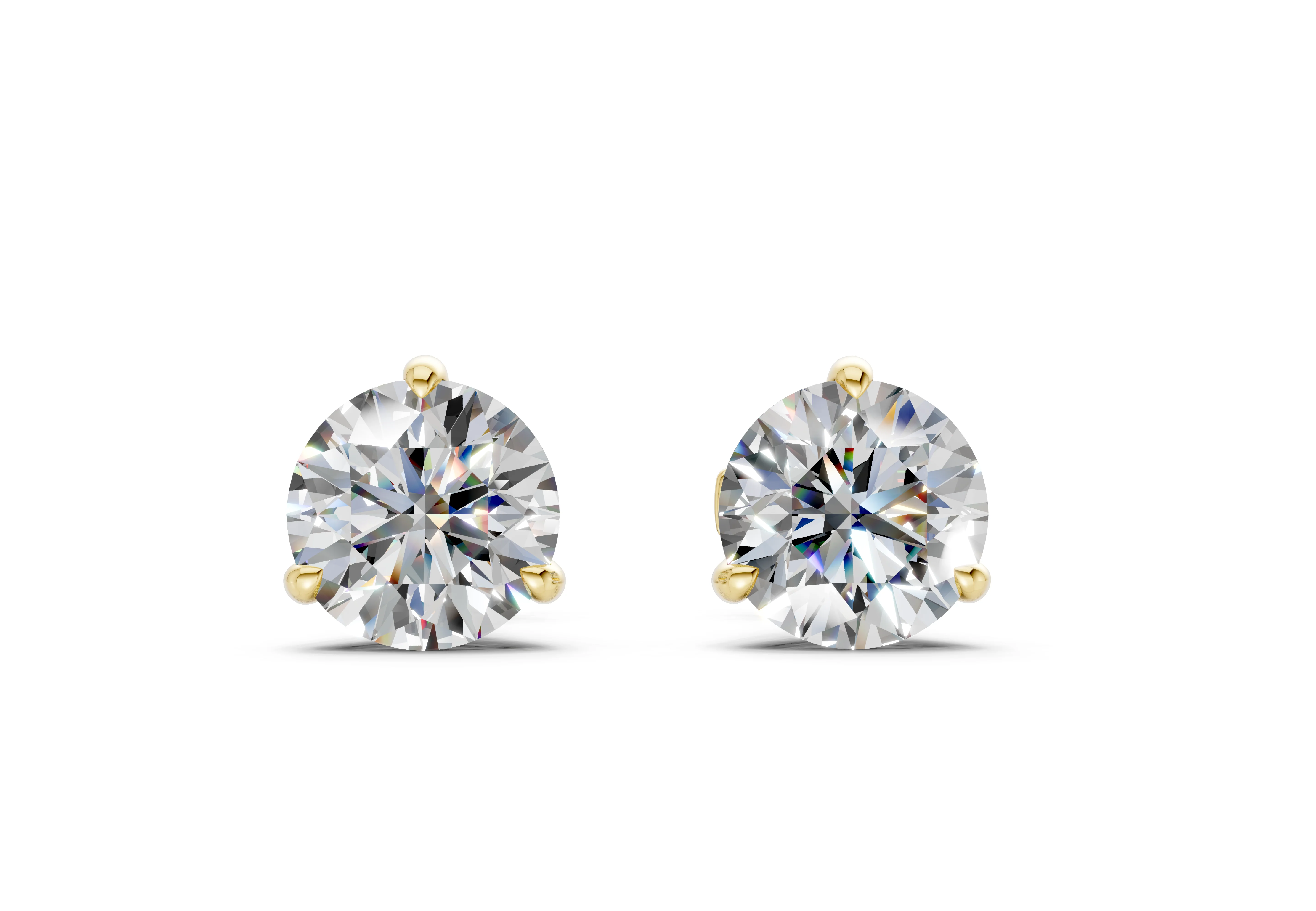
Geneva Classic Diamond Round Cut Studs - D VVS1
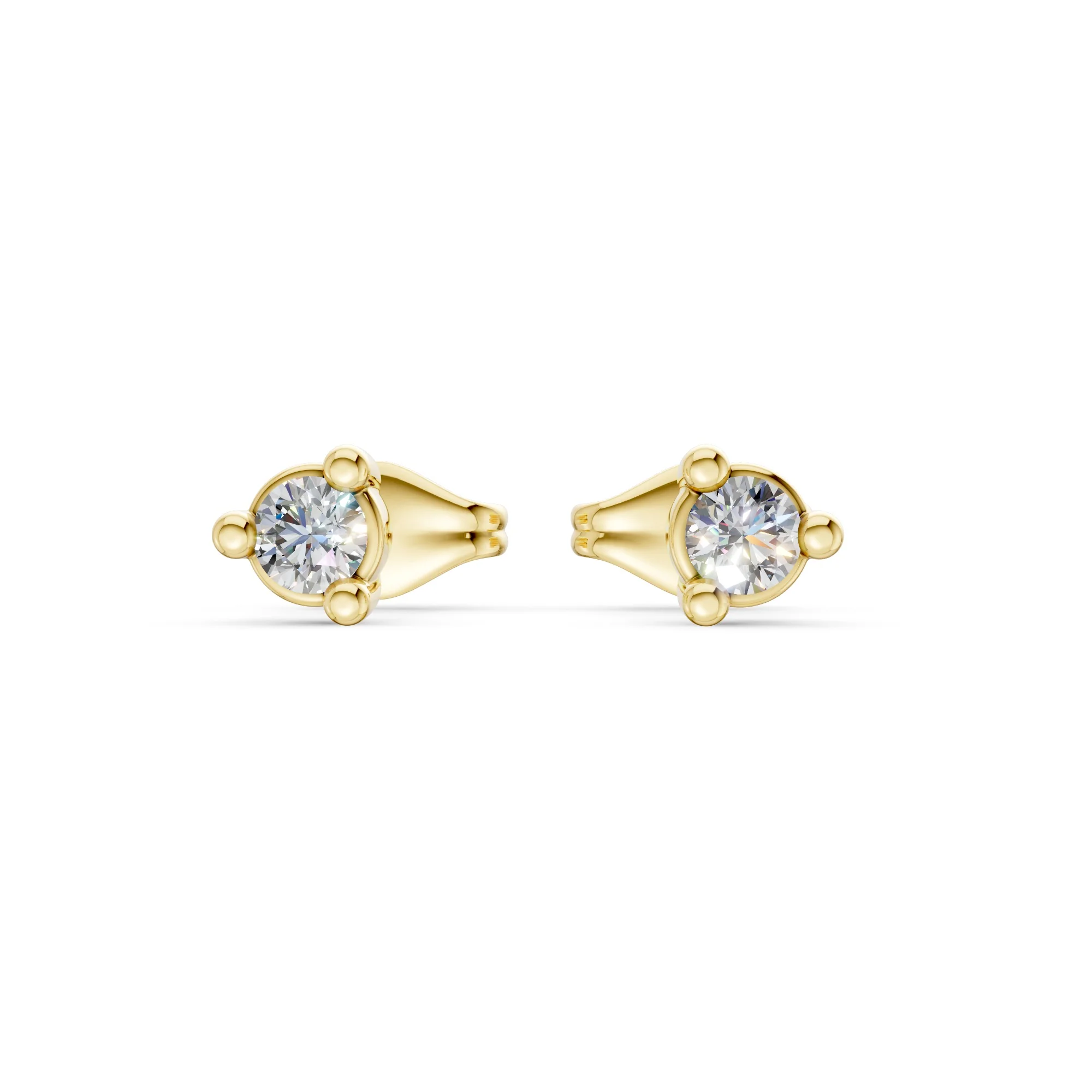
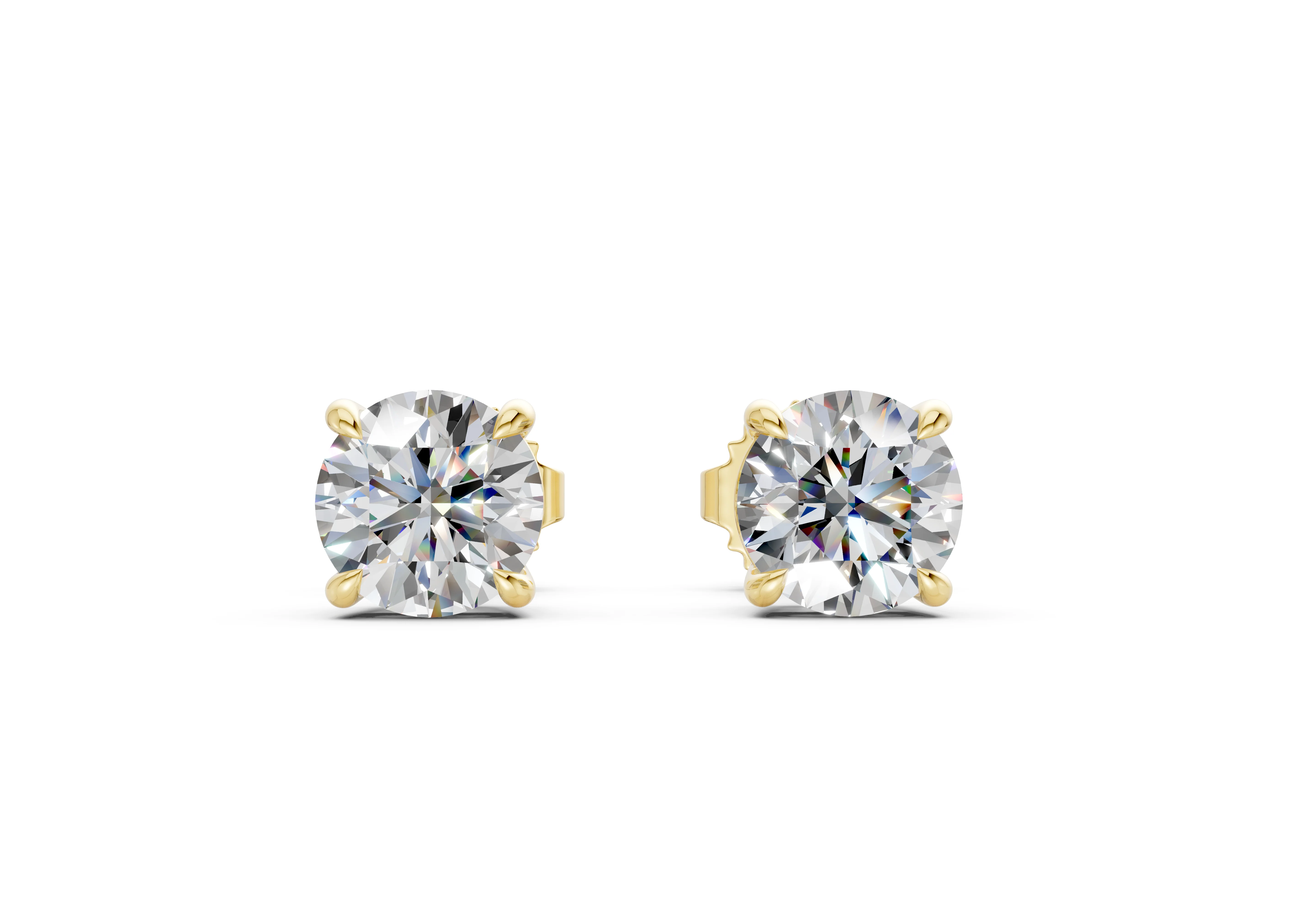
The pair you put on without thinking and notice every time you pass a mirror. Geneva Round Cut D VVS1 studs hold a colorless, near-flawless lab diamond in the four-prong basket setting that has defined fine-jewelry studs for a century — with the highest combined color-and-clarity grade Ring Premier offers in this style.
The open basket lets light enter from above, through the open gallery, and from the sides at once. At the D VVS1 tier, what comes back is light without warmth and brilliance without distraction.
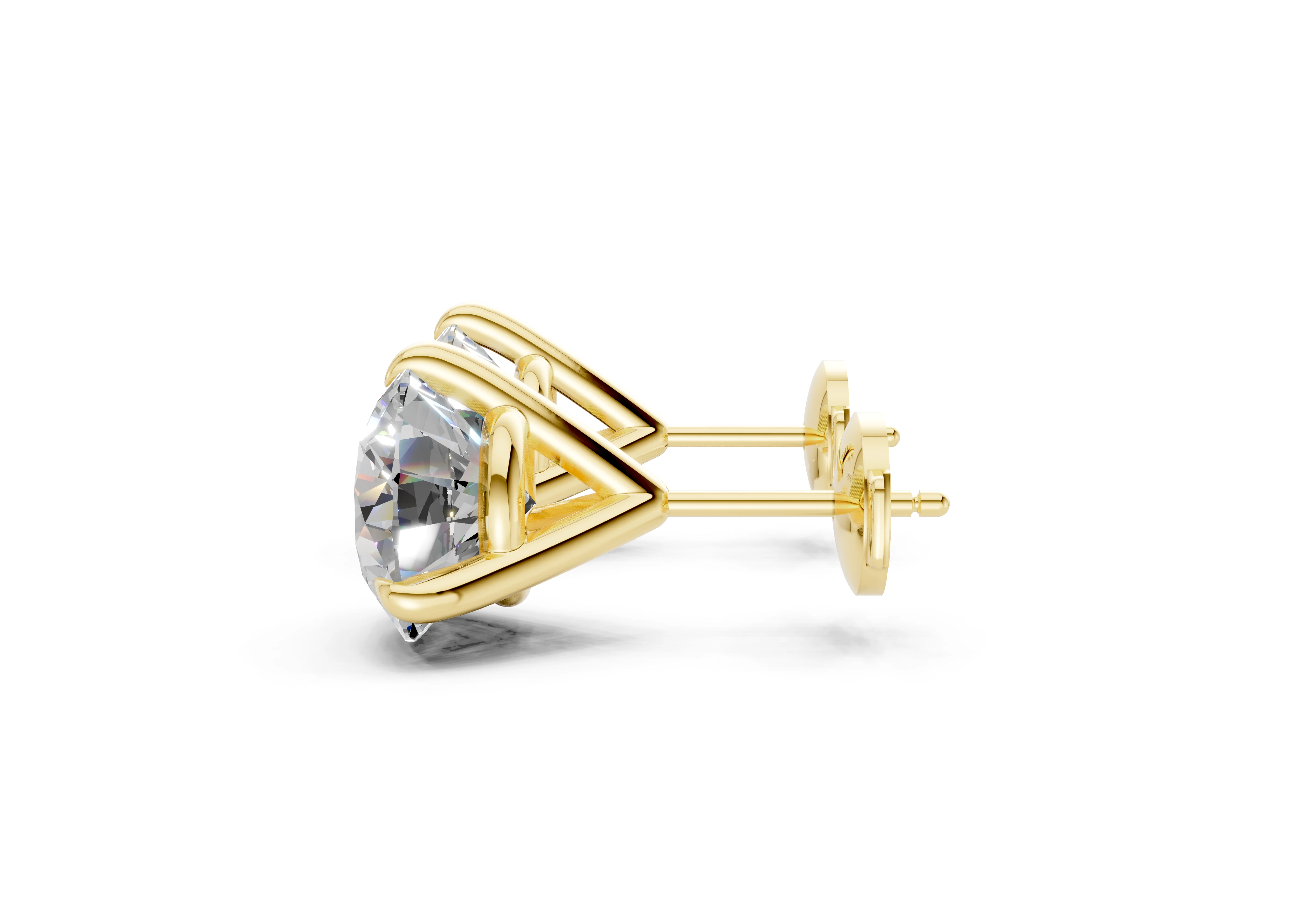
Three closures available: Screw-back for security in travel and daily wear, Push-back (friction butterfly) for the quickest on-and-off, and Guardian-back for an extra locking layer on higher carat weights (+$125 over Screw-back).
Specifications
- Color Grade: D — Colorless, the highest grade on the GIA scale
- Clarity Grade: VVS1 — Very Very Slightly Included, Grade 1; the higher VVS tier
- Cut: Round Brilliant, Ideal Cut
- Setting: Four-prong basket mount with open gallery
- Closure: Screw-back, Push-back, or Guardian-back
- Metal: 14K or 18K Solid Gold (White, Yellow, or Rose) or PT950 Platinum
- Carat Weight: 0.50 to 5.00 CTW — select at checkout
- Certification: IGI grading report at 1.00 CTW and above; Certificate of Authenticity for all sizes
- Origin: Lab-grown; recycled metals; 100% carbon-neutral verified by Clear Neutral
D VVS1 is the top combined color-and-clarity grade Ring Premier offers in the Geneva collection. D color sits at the head of the GIA color scale — fully colorless with no warmth or tint visible from any angle. VVS1 inclusions are so minor a trained gemologist with a 10× loupe needs time to locate them. The E VVS2 sibling is a step down on each scale and visually indistinguishable to a non-specialist in normal lighting. D VVS1 is the certificate, not the appearance — chosen by buyers who want the grading report to match the investment.
- Free fully insured shipping with tracking
- 30-day free returns
- Premium handcrafted jewelry box
- Professional cleaning, rhodium re-plating, and prong retipping available
- Soak in warm water with a drop of mild dish soap; brush gently around prongs and gallery with a soft-bristle toothbrush; pat dry with a lint-free cloth
- Store separately to avoid scratching against other pieces
What does D VVS1 actually look like compared to E VVS2?
Almost identical to the naked eye. Both are colorless or near-colorless under daylight and indoor lighting, and both are eye-clean to a non-specialist. The differences appear under controlled conditions: D is fully colorless against a white background where E may show the faintest hint of warmth to a careful eye; a VVS1 inclusion typically takes a gemologist longer to locate under a 10× loupe than a VVS2. The largest practical difference is on the grading certificate.
Which closure should I choose?
Push-back is the lightest and fastest, best for daily wear at smaller carat weights. Screw-back is more secure and recommended if you travel, exercise, or sleep in your studs. Guardian-back adds a locking mechanism behind the closure and is recommended for 2 CTW and above where the stone weight makes accidental loss more costly. Guardian-back is +$125 over the equivalent Screw-back variant.
Are these certified?
Every round stud at 1.00 CTW and above ships with an IGI (International Gemological Institute) grading report. Below 1.00 CTW, each pair ships with a professional appraisal and Certificate of Authenticity accepted by major insurance carriers. The IGI report names the D color and VVS1 clarity grades on every certified pair.
Why a four-prong basket instead of a martini mount?
The four-prong basket is the most widely used setting in diamond studs and the silhouette most people picture when they think "diamond stud earring." Four prongs grip the stone at the crown, the open gallery underneath lets light through the pavilion, and the symmetry favors stones that are face-up generous — round brilliants in particular. The martini setting (Florence) uses three prongs and sits closer to the lobe; choose Geneva if you want the more traditional stud profile, Florence if you want a lower-profile aesthetic.
Lab-grown vs mined — is there any optical difference?
No. Lab-grown diamonds are the same material, same crystal structure, same hardness (10 on the Mohs scale), same refractive index. The IGI report uses the same grading scales for both. The only verifiable difference requires specialized laboratory equipment; a jeweler cannot tell them apart under a loupe.
Original: $533.00
-65%$533.00
$186.55More Images
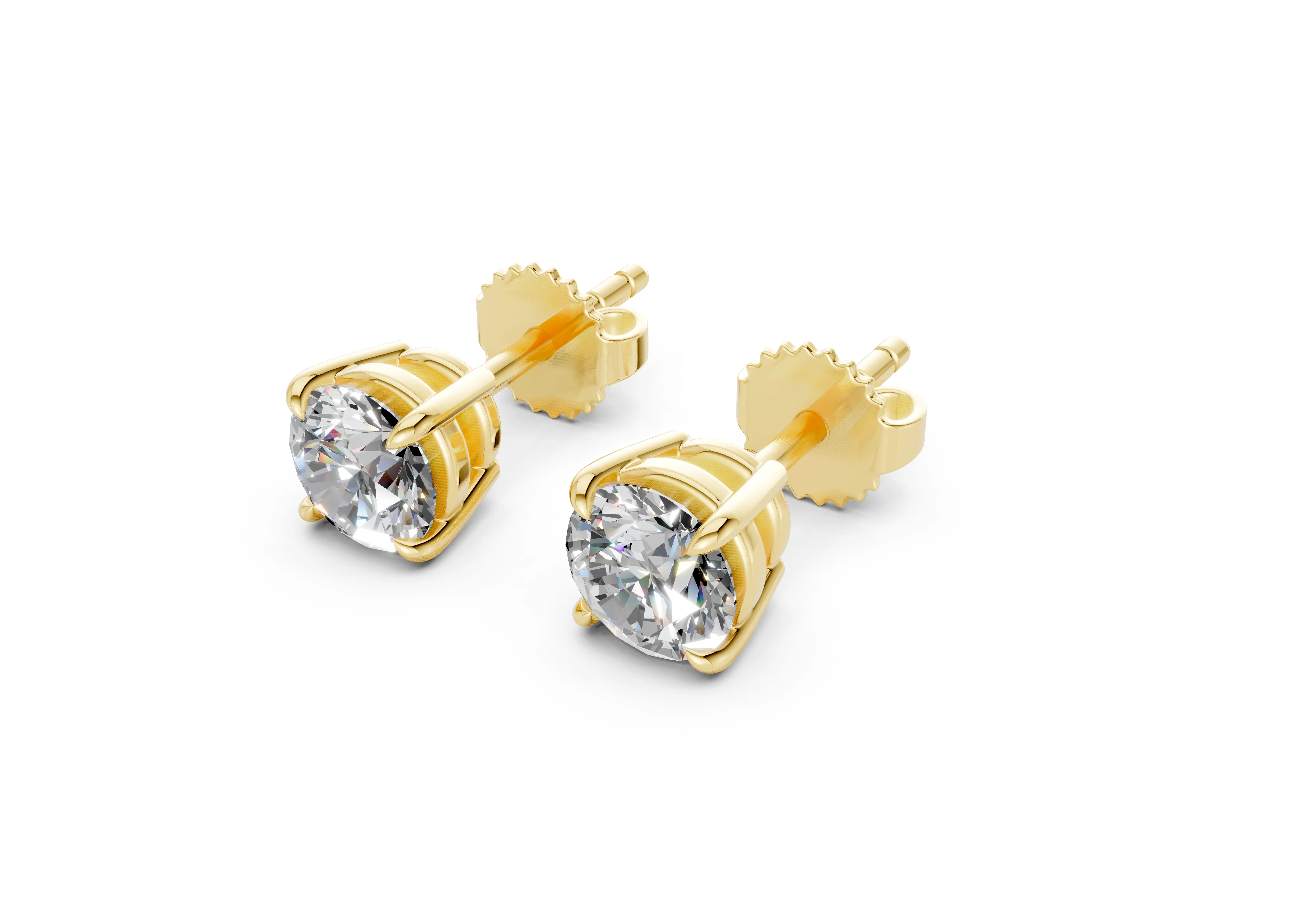


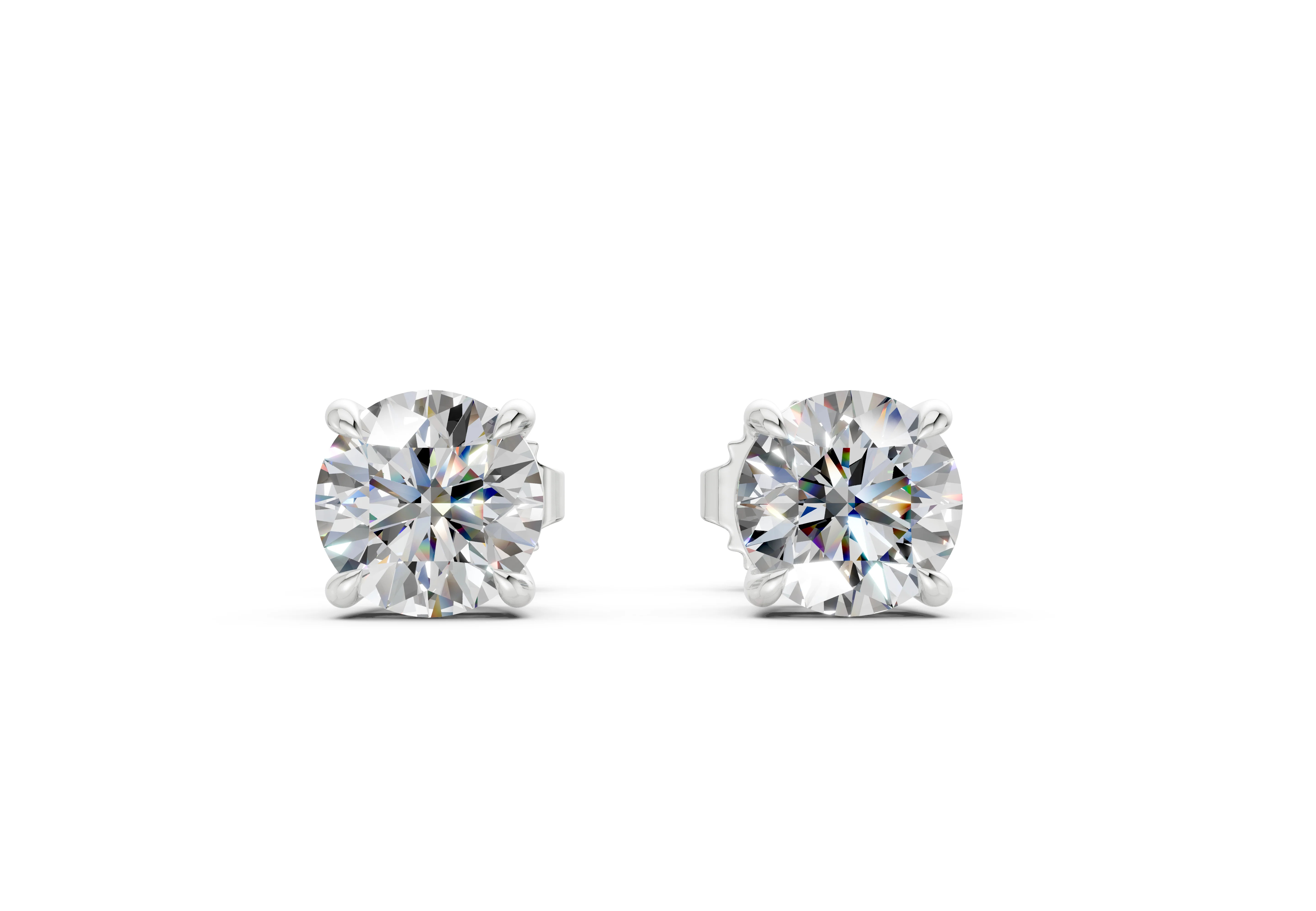


Geneva Classic Diamond Round Cut Studs - D VVS1
The pair you put on without thinking and notice every time you pass a mirror. Geneva Round Cut D VVS1 studs hold a colorless, near-flawless lab diamond in the four-prong basket setting that has defined fine-jewelry studs for a century — with the highest combined color-and-clarity grade Ring Premier offers in this style.
The open basket lets light enter from above, through the open gallery, and from the sides at once. At the D VVS1 tier, what comes back is light without warmth and brilliance without distraction.
Three closures available: Screw-back for security in travel and daily wear, Push-back (friction butterfly) for the quickest on-and-off, and Guardian-back for an extra locking layer on higher carat weights (+$125 over Screw-back).
Specifications
- Color Grade: D — Colorless, the highest grade on the GIA scale
- Clarity Grade: VVS1 — Very Very Slightly Included, Grade 1; the higher VVS tier
- Cut: Round Brilliant, Ideal Cut
- Setting: Four-prong basket mount with open gallery
- Closure: Screw-back, Push-back, or Guardian-back
- Metal: 14K or 18K Solid Gold (White, Yellow, or Rose) or PT950 Platinum
- Carat Weight: 0.50 to 5.00 CTW — select at checkout
- Certification: IGI grading report at 1.00 CTW and above; Certificate of Authenticity for all sizes
- Origin: Lab-grown; recycled metals; 100% carbon-neutral verified by Clear Neutral
D VVS1 is the top combined color-and-clarity grade Ring Premier offers in the Geneva collection. D color sits at the head of the GIA color scale — fully colorless with no warmth or tint visible from any angle. VVS1 inclusions are so minor a trained gemologist with a 10× loupe needs time to locate them. The E VVS2 sibling is a step down on each scale and visually indistinguishable to a non-specialist in normal lighting. D VVS1 is the certificate, not the appearance — chosen by buyers who want the grading report to match the investment.
- Free fully insured shipping with tracking
- 30-day free returns
- Premium handcrafted jewelry box
- Professional cleaning, rhodium re-plating, and prong retipping available
- Soak in warm water with a drop of mild dish soap; brush gently around prongs and gallery with a soft-bristle toothbrush; pat dry with a lint-free cloth
- Store separately to avoid scratching against other pieces
What does D VVS1 actually look like compared to E VVS2?
Almost identical to the naked eye. Both are colorless or near-colorless under daylight and indoor lighting, and both are eye-clean to a non-specialist. The differences appear under controlled conditions: D is fully colorless against a white background where E may show the faintest hint of warmth to a careful eye; a VVS1 inclusion typically takes a gemologist longer to locate under a 10× loupe than a VVS2. The largest practical difference is on the grading certificate.
Which closure should I choose?
Push-back is the lightest and fastest, best for daily wear at smaller carat weights. Screw-back is more secure and recommended if you travel, exercise, or sleep in your studs. Guardian-back adds a locking mechanism behind the closure and is recommended for 2 CTW and above where the stone weight makes accidental loss more costly. Guardian-back is +$125 over the equivalent Screw-back variant.
Are these certified?
Every round stud at 1.00 CTW and above ships with an IGI (International Gemological Institute) grading report. Below 1.00 CTW, each pair ships with a professional appraisal and Certificate of Authenticity accepted by major insurance carriers. The IGI report names the D color and VVS1 clarity grades on every certified pair.
Why a four-prong basket instead of a martini mount?
The four-prong basket is the most widely used setting in diamond studs and the silhouette most people picture when they think "diamond stud earring." Four prongs grip the stone at the crown, the open gallery underneath lets light through the pavilion, and the symmetry favors stones that are face-up generous — round brilliants in particular. The martini setting (Florence) uses three prongs and sits closer to the lobe; choose Geneva if you want the more traditional stud profile, Florence if you want a lower-profile aesthetic.
Lab-grown vs mined — is there any optical difference?
No. Lab-grown diamonds are the same material, same crystal structure, same hardness (10 on the Mohs scale), same refractive index. The IGI report uses the same grading scales for both. The only verifiable difference requires specialized laboratory equipment; a jeweler cannot tell them apart under a loupe.
Product Information
Product Information
Shipping & Returns
Shipping & Returns
Description
The pair you put on without thinking and notice every time you pass a mirror. Geneva Round Cut D VVS1 studs hold a colorless, near-flawless lab diamond in the four-prong basket setting that has defined fine-jewelry studs for a century — with the highest combined color-and-clarity grade Ring Premier offers in this style.
The open basket lets light enter from above, through the open gallery, and from the sides at once. At the D VVS1 tier, what comes back is light without warmth and brilliance without distraction.
Three closures available: Screw-back for security in travel and daily wear, Push-back (friction butterfly) for the quickest on-and-off, and Guardian-back for an extra locking layer on higher carat weights (+$125 over Screw-back).
Specifications
- Color Grade: D — Colorless, the highest grade on the GIA scale
- Clarity Grade: VVS1 — Very Very Slightly Included, Grade 1; the higher VVS tier
- Cut: Round Brilliant, Ideal Cut
- Setting: Four-prong basket mount with open gallery
- Closure: Screw-back, Push-back, or Guardian-back
- Metal: 14K or 18K Solid Gold (White, Yellow, or Rose) or PT950 Platinum
- Carat Weight: 0.50 to 5.00 CTW — select at checkout
- Certification: IGI grading report at 1.00 CTW and above; Certificate of Authenticity for all sizes
- Origin: Lab-grown; recycled metals; 100% carbon-neutral verified by Clear Neutral
D VVS1 is the top combined color-and-clarity grade Ring Premier offers in the Geneva collection. D color sits at the head of the GIA color scale — fully colorless with no warmth or tint visible from any angle. VVS1 inclusions are so minor a trained gemologist with a 10× loupe needs time to locate them. The E VVS2 sibling is a step down on each scale and visually indistinguishable to a non-specialist in normal lighting. D VVS1 is the certificate, not the appearance — chosen by buyers who want the grading report to match the investment.
- Free fully insured shipping with tracking
- 30-day free returns
- Premium handcrafted jewelry box
- Professional cleaning, rhodium re-plating, and prong retipping available
- Soak in warm water with a drop of mild dish soap; brush gently around prongs and gallery with a soft-bristle toothbrush; pat dry with a lint-free cloth
- Store separately to avoid scratching against other pieces
What does D VVS1 actually look like compared to E VVS2?
Almost identical to the naked eye. Both are colorless or near-colorless under daylight and indoor lighting, and both are eye-clean to a non-specialist. The differences appear under controlled conditions: D is fully colorless against a white background where E may show the faintest hint of warmth to a careful eye; a VVS1 inclusion typically takes a gemologist longer to locate under a 10× loupe than a VVS2. The largest practical difference is on the grading certificate.
Which closure should I choose?
Push-back is the lightest and fastest, best for daily wear at smaller carat weights. Screw-back is more secure and recommended if you travel, exercise, or sleep in your studs. Guardian-back adds a locking mechanism behind the closure and is recommended for 2 CTW and above where the stone weight makes accidental loss more costly. Guardian-back is +$125 over the equivalent Screw-back variant.
Are these certified?
Every round stud at 1.00 CTW and above ships with an IGI (International Gemological Institute) grading report. Below 1.00 CTW, each pair ships with a professional appraisal and Certificate of Authenticity accepted by major insurance carriers. The IGI report names the D color and VVS1 clarity grades on every certified pair.
Why a four-prong basket instead of a martini mount?
The four-prong basket is the most widely used setting in diamond studs and the silhouette most people picture when they think "diamond stud earring." Four prongs grip the stone at the crown, the open gallery underneath lets light through the pavilion, and the symmetry favors stones that are face-up generous — round brilliants in particular. The martini setting (Florence) uses three prongs and sits closer to the lobe; choose Geneva if you want the more traditional stud profile, Florence if you want a lower-profile aesthetic.
Lab-grown vs mined — is there any optical difference?
No. Lab-grown diamonds are the same material, same crystal structure, same hardness (10 on the Mohs scale), same refractive index. The IGI report uses the same grading scales for both. The only verifiable difference requires specialized laboratory equipment; a jeweler cannot tell them apart under a loupe.